Skip to content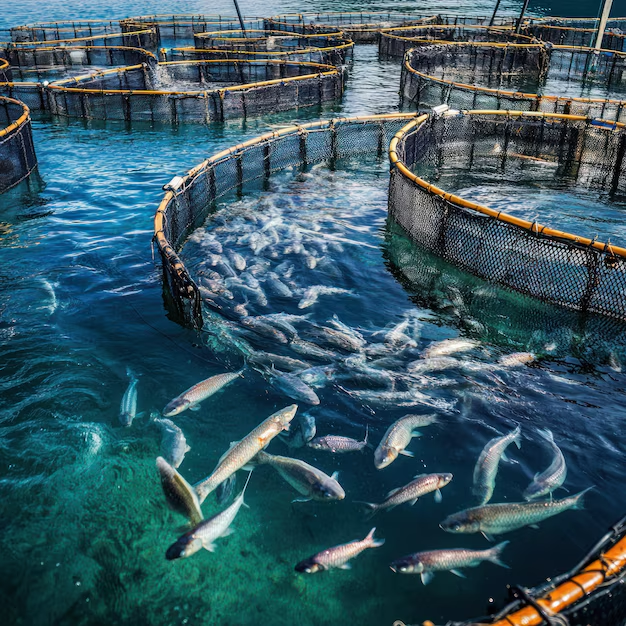
The First FAO-CFA Joint International Conference on Sustainable Aquaculture took place in Fuzhou, highlighting China’s strides in modernizing aquaculture through environmentally friendly and technologically advanced practices. The three-day conference attracted experts from around the globe to examine innovations shaping sustainable seafood production.
Along China’s southeastern coast, multi-story fish and shrimp farms are achieving water reuse rates exceeding 90 percent through water-saving techniques, wastewater treatment, and recycling. This reflects the industry’s commitment to eco-friendly practices while maintaining high productivity.
In Guangze County, rice paddies are being co-cultivated with fish, shrimp, and crabs, allowing farmers to harvest both crops and seafood from the same field. The approach reduces pesticide use and significantly boosts farmers’ incomes. As Yeong Yik Sung, a professor at the Institute of Climate Adaptation and Marine Biotechnology, observed, “China implements multi-trophic aquaculture along the Yellow Sea coastline. By cultivating seaweed, shellfish, and fish together in a single ecosystem, the system cleverly recycles nitrogen and phosphorus.”
South African aquaculture expert Belemane Semoli, chief director of aquaculture development and inland fisheries, noted that China’s efforts cover the full spectrum of the sector: “From site selection and planning, regional layout, and farming operations, to harvesting techniques, post-harvest handling and waste reduction, China has put in place a series of exemplary measures.” She added, “China has always placed sustainability at the core while driving industry growth.”
China’s aquaculture output remains unmatched. In 2025, the country produced over 63 million tonnes, accounting for about 56 percent of global output. The broader fishing industry generated 3.4 trillion yuan (around 493.5 billion U.S. dollars) and provided employment for tens of millions along the production chain. With 83 percent of total fishery production now from aquaculture, China is easing pressure on wild fisheries.
Advanced technologies are integral to this transformation. In Dinghai Bay, 5G networks and intelligent sensors monitor water quality, oxygen levels, temperature, and fish growth, streamlining farm operations. The Guoxin-1, a mobile aquaculture platform operating in the Yellow Sea and East Sea, raises species such as large yellow croaker, grouper, and Atlantic salmon. It circulates over 80,000 cubic meters of seawater within onboard tanks and can autonomously relocate to avoid typhoons, red tides, and other hazards. Yeong described it as “a smart, industrialized and mobile aquaculture platform [that] represents the future direction of seafood farming.”
Xiao Fang, director of the Fisheries and Fishery Administration, highlighted China’s species diversity, noting that the country has “developed and cultivated a total of 640 aquaculture species,” reflecting its commitment to sustainability and innovation.
From a global perspective, Manuel Barange, assistant director-general and director of the Fisheries and Aquaculture Division at the Food and Agriculture Organization, emphasized the international significance: “I’ve seen a country that has committed to developing a sustainable blue economy with people at heart to ending hunger and poverty. I’m very impressed about that.”
China’s integration of sustainable practices, technological innovation, and community benefits offers a model for countries seeking solutions to hunger, malnutrition, and poverty, demonstrating how aquaculture can drive a resilient “blue economy.”
By Samuel Mwangi