Skip to content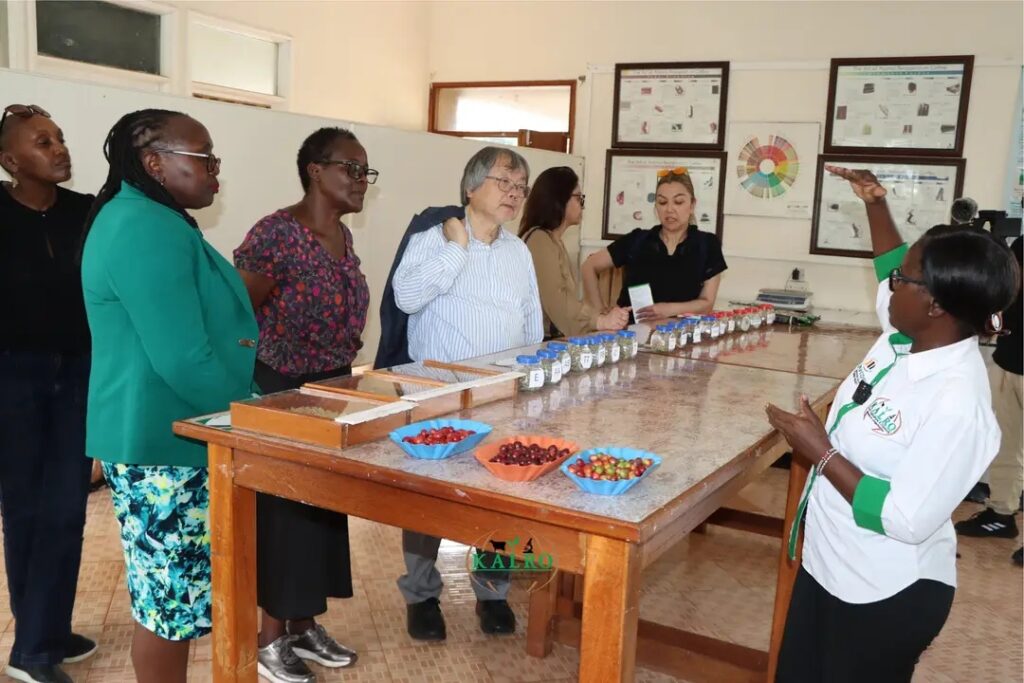
A high-level delegation from the World Bank has visited the Kenya Agricultural and Livestock Research Organization Coffee Research Institute (CRI) to assess how research, innovation, and financial support are being used to improve coffee farming and boost agricultural commercialization in Kenya.
The visit focused on projects being implemented under the National Agricultural Value Chain Development Project (NAVCDP), a World Bank-funded programme aimed at enhancing agricultural productivity, increasing farmers’ incomes, and promoting commercialization across key value chains.
The delegation was led by Akihiko Nishio and accompanied by NAVCDP National Coordinator Samuel Guto. They were received by KALRO Deputy Director General for Crops Alice Murage on behalf of Director General Patrick Ketiem, alongside KALRO-CRI Director Zachary Kinyua.
The visit highlighted how partnerships between research institutions and development partners are helping improve coffee production through the development of better technologies, improved seedlings, and farmer training programmes.
Speaking during the visit, Dr. Murage explained that KALRO has been using support from the World Bank to develop and disseminate technologies that help farmers improve productivity and strengthen resilience against challenges such as climate change and crop diseases.
“KALRO plays a critical role in generating agricultural technologies and innovations that support productivity and improve livelihoods,” said Dr. Murage.
She noted that several research projects implemented through World Bank support have already recorded high adoption rates among farmers, contributing to increased yields and improved commercialization of agriculture.
The delegation also explored how KALRO-CRI is addressing the growing demand for quality coffee planting materials. According to Dr. Kinyua, the institute has intensified efforts to produce certified coffee seeds and seedlings to meet farmers’ needs.
“The demand for quality coffee seeds and seedlings continues to rise, and enhanced financial and infrastructural support will help bridge the gap between demand and the availability of authentic planting materials,” he said.
Dr. Kinyua emphasized that collaboration between research institutions and development partners is essential in scaling up seed production and ensuring farmers access improved coffee technologies.
The World Bank delegation toured research laboratories, seed production units, and demonstration areas at the institute to understand how the technologies are being developed and distributed to farmers.
Researchers at the institute explained that improved coffee varieties being promoted are more productive, disease-resistant, and better suited to changing climatic conditions. Farmers are also being trained on modern agronomic practices aimed at improving coffee quality and increasing profitability.
Officials noted that the innovations being implemented are gradually transforming coffee farming from a subsistence activity into a commercially viable agribusiness capable of improving rural livelihoods.
The National Agricultural Value Chain Development Project is also supporting value addition and market access initiatives to ensure farmers benefit more from coffee production.
The visit underscored the importance of research-driven agriculture and international partnerships in strengthening Kenya’s coffee sector and supporting long-term food and economic security.
By: Samuel Mwangi