Skip to content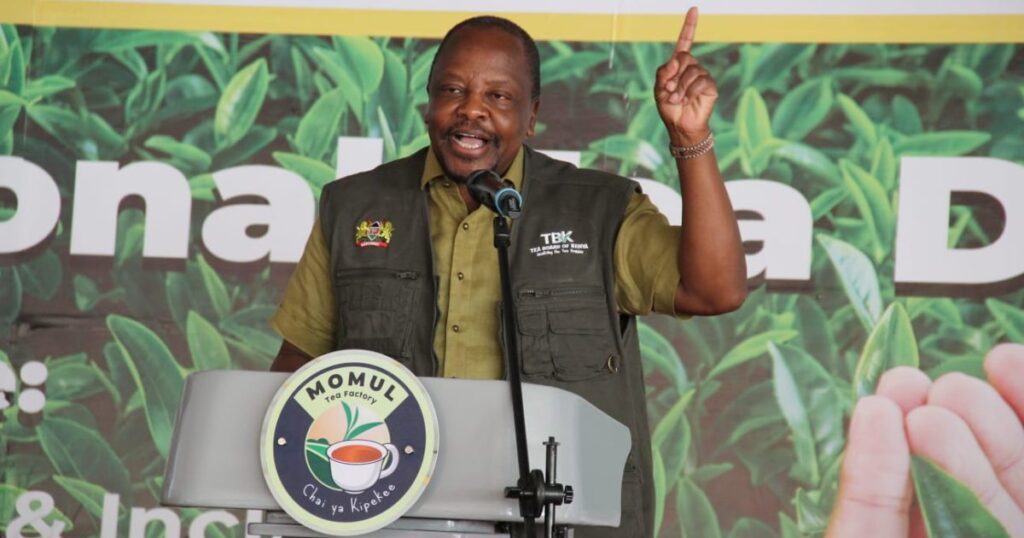
The government has intensified reforms in the tea sector aimed at increasing farmer incomes through value addition, expansion of export markets, and stronger global branding of Kenyan tea, Agriculture and Livestock Development Cabinet Secretary Mutahi Kagwe has said.
Speaking during International Tea Day celebrations held at Momul Tea Factory in Kericho County, Kagwe said the reforms are designed to transform the industry into a modern and competitive sector that can generate more wealth for farmers while creating employment opportunities for young people.
He noted that tea remains a key agricultural commodity supporting millions of livelihoods across the value chain and is among Kenya’s leading foreign exchange earners. He further praised Kenya’s global standing as a top exporter of black CTC tea, attributing it to the quality and consistency of local production.
Kagwe, however, acknowledged that the sector continues to face challenges, including fluctuating global prices, high production costs, climate change, market volatility, and overdependence on a few export destinations. He also appreciated long-standing tea importers such as Pakistan, Egypt, Sudan, India, and Sri Lanka for sustaining demand for Kenyan tea.
The Cabinet Secretary said the government, under President William Ruto, is implementing reforms focused on value addition and diversification of export markets, especially in Asia. He disclosed that Kenya has secured duty-free access for tea exports to China following bilateral engagements.
Kagwe emphasized the need for more local processing and packaging, warning that exporting raw tea leads to loss of jobs.
“Every time we export tea in sacks, we are exporting jobs to other countries. We need those jobs here in Kenya for our young people.” He stated.
He also called for stronger policy measures to ensure more tea is processed locally, saying this would stimulate industrial growth and create employment.
On sustainability, Kagwe highlighted the promotion of climate-smart agriculture, renewable energy use, water management, and environmental conservation in tea-growing regions to secure the sector’s future. He also linked tree-planting efforts during the event to the national goal of planting 15 billion trees by 2032.
The CS further encouraged youth involvement in agriculture, noting that innovation and digital platforms can make the sector more attractive and profitable for young people.
On the proposed Tea Levy set for 2026, Kagwe defended it as a funding mechanism for promotion, research, branding, and market expansion. He assured stakeholders that the levy would be reinvested into strengthening the industry and not burden farmers.
He urged critics of the levy to engage the government in dialogue instead of pursuing court battles, arguing that similar levies exist in other tea-producing countries, especially in Asia.
Kagwe also stressed the importance of protecting Kenya’s geographical identity in global markets to prevent local tea from being rebranded abroad.
“We want consumers across the world to specifically identify and demand Kenya tea. That is why we must invest heavily in branding and promotion globally.” Kagwe said.
He added that the government is pushing for ethical sourcing, environmental stewardship, and decent labour standards to maintain international confidence in Kenyan tea. He further noted that farmers currently receive up to 79 percent of tea sales earnings under existing regulations.
Kagwe commended Momul Tea Factory for its modernization and urged other factories to emulate its model. He also donated over 100,000 tea seedlings and 100,000 avocado seedlings to farmers in Kericho.
The event was attended by several leaders including Kericho Senator Aaron Cheruiyot, Agriculture PS Paul Rono, Ambassador Florence Bore, KTDA National Chairman Enos Njeru, and Kenya Tea Board CEO Willy Mutai among others.
By; Catherine Kamunyo